Howdy, Samir here
Robotics Software Engineer
I like to build autonomous systems
I started in mechanical engineering, building an intuition for physical systems before going deep on the software that controls them. Knowing why a robot fails in the real world and how to fix it in code is what I've built my career around.
For six years I've specialized in Guidance, Navigation, and Control, shipping mission-critical autonomy software for vehicles across land, air, and sea domains. The work involves sensor fusion, state estimation, and control algorithms that have to stay reliable when GPS drops out, environments are unstructured, and the stakes are physical.
Lately I've been expanding upstream, building the distributed simulation and infrastructure tooling that lets teams validate autonomous behavior before hardware ever enters the picture. The harder problems in robotics are often the engineering ones, not the algorithmic ones.
Oct 2021 - Feb 2024
Core developer for the OPENSEA autonomy platform, deploying mission-critical GNC software to commercial underwater fleets. Specifically, I engineered solutions for SLAM-based navigation, sensor fusion, and obstacle avoidance on the 'EverClean' hull-cleaning robots, 'Bayonet' amphibious crawlers.
May 2020 - Sep 2021
R&D focus on multi-agent coordination between autonomous air and ground vehicles in unstructured, off-road environments. I engineered real-time perception pipelines (LiDAR to 2D Costmap) and developed local planners for obstacle avoidance.
Aug 2018 - May 2020
Designed and validated data-driven, nonlinear control architectures for a drive-by-wire UTV. I developed system identification models to characterize vehicle dynamics and implemented Sliding Mode Controllers for precise off-road path tracking.
Aug 2017 - May 2018
Led controls development for Texas A&M's SAE AutoDrive entry, placing 2nd overall in the inaugural competition. Designed and implemented the full controls stack for a commercial autonomous vehicle, covering lateral and longitudinal control for urban driving scenarios.
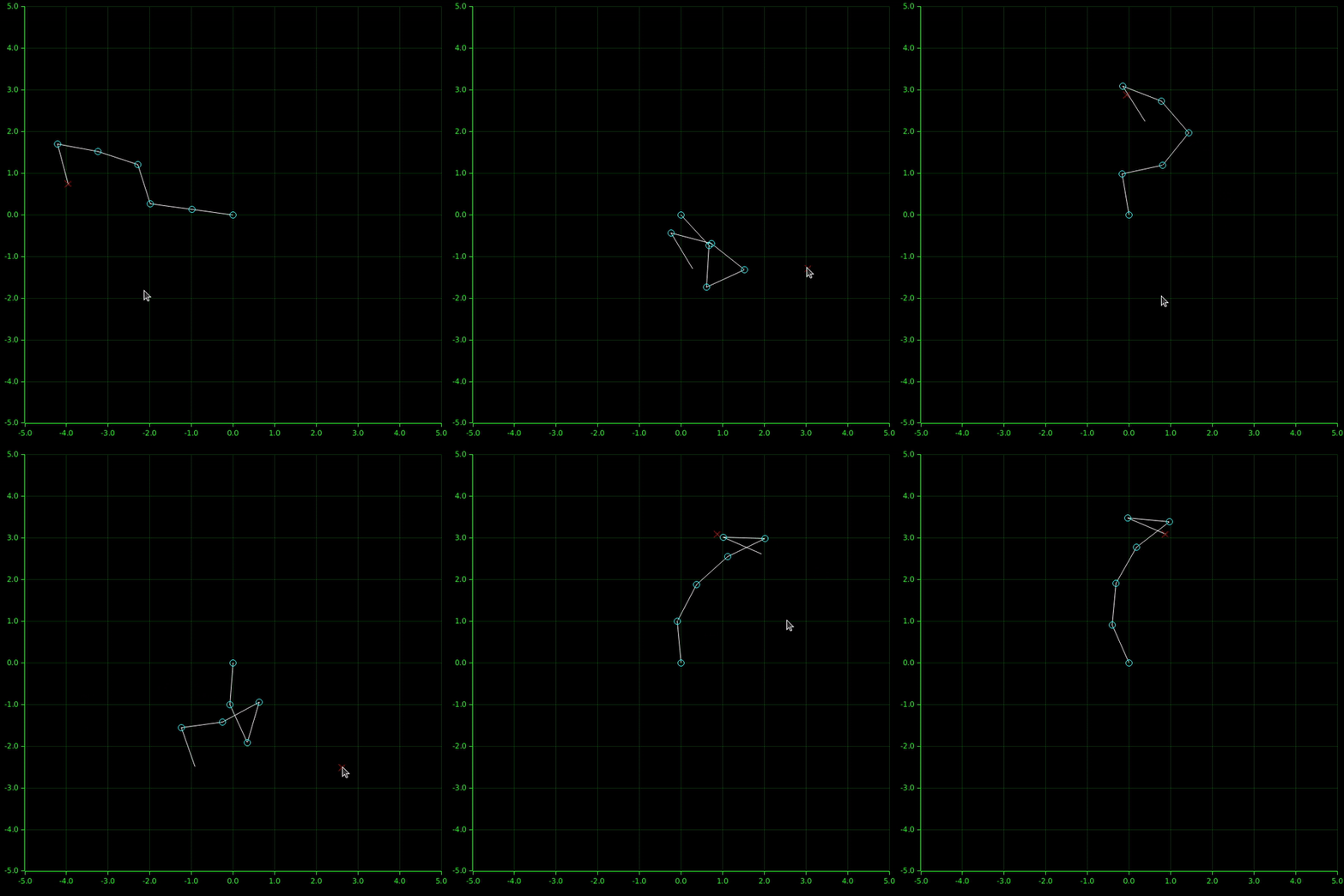
A high-fidelity robotics simulator architected in Rust using the Bevy game engine (ECS). I implemented rigid body dynamics and sensor models (IMU, LiDAR) from first principles to benchmark GNC algorithms in a deterministic synthetic environment. The system features a hot-swappable plugin architecture that bridges the gap between theoretical MATLAB control design and real-time Rust implementation.

A Generative Pretrained Model (GPT) using a decoder architecture similar to "Attention is All You Need," trained on scripts from "The Office" to generate dialogue in the show's style. Implements custom character-wise and GPT-2 tokenization methods. Originally trained on a single GPU, with future plans to scale to multi-GPU distributed training.
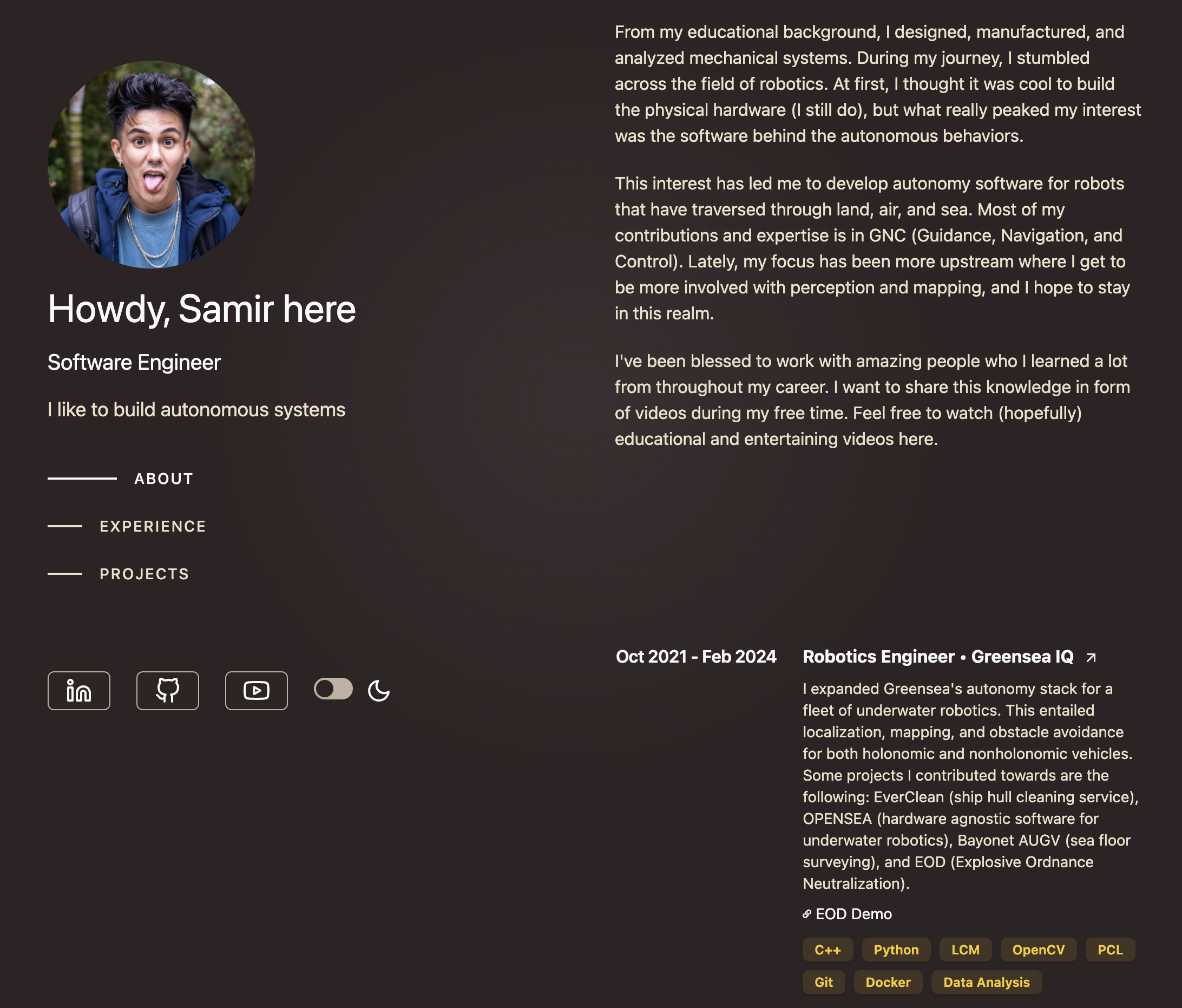
Portfolio built with Next.js, TypeScript, and Tailwind CSS. Architected around a single JSON config file so all content — bio, experience, projects — can be updated without touching component code.
Brittany Chiang's website design was my inspiration. Next.js, Tailwind CSS, and shadcn/ui were used to build this portfolio website.